Exploring Hokuriku: Mountains, Castle-Town Culture, Hot Springs and Dinosaurs in Toyama, Ishikawa and Fukui
September 20, 2026
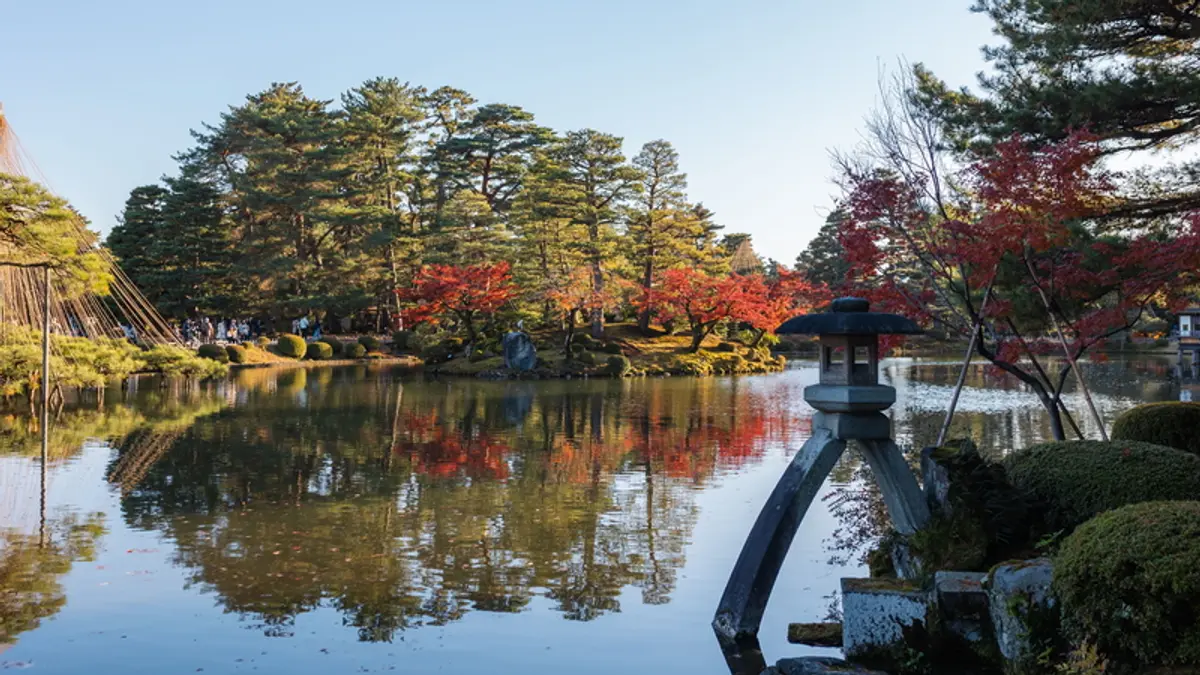
Hokuriku faces the Sea of Japan between the high mountains of central Honshu and the coast. Toyama, Ishikawa and Fukui are linked by the Hokuriku Shinkansen, but the three prefectures offer very different reasons to stop. Toyama is especially well suited to alpine scenery and quiet rural landscapes. Ishikawa combines Kanazawa’s preserved urban culture with hot-spring towns. Fukui is especially rewarding for travelers interested in Zen Buddhism, dinosaurs and dramatic coastal scenery.
The region works well as a multi-stop trip, but it does not need to be treated as one continuous itinerary. If your time is limited, choosing one or two bases and making focused side trips is usually more satisfying than trying to cover all three prefectures quickly.
Toyama City and Tateyama — city comfort beside the Northern Alps
Toyama City is often treated as a gateway, but it is also a comfortable place to spend time in its own right. Around the station, the city feels open and modern, with the mountains forming a dramatic background on clear days. Fugan Canal Kansui Park is an easy walk from Toyama Station, while the Toyama Glass Art Museum brings contemporary design into the center of town. Toyama Bay seafood is another reason to stay rather than simply change trains.
The city becomes especially valuable when paired with Tateyama. The Tateyama Kurobe Alpine Route crosses the Northern Alps using a sequence of mountain transport including cable cars, buses and a ropeway. On the Toyama side, Tateyama Station is the main starting point. Higher up, Murodo is known for its spring snow walls and high-altitude scenery.
This is a strongly seasonal destination. In 2026 the Alpine Route operates from April 15 to November 30, and travelers should check the official schedule for future years. The famous snow corridor is primarily a spring experience. Weather at elevation can also be very different from conditions in Toyama City. For travelers whose main goal is mountains, Toyama is therefore best understood as a flexible city base for a weather-dependent alpine excursion rather than merely a station on the way elsewhere.
Gokayama — a quieter mountain landscape of gassho-style villages
In southwestern Toyama Prefecture, Gokayama offers a completely different atmosphere. Ainokura and Suganuma are part of the UNESCO World Heritage listing shared with Shirakawa-go, preserving settlements of steeply thatched gassho-style farmhouses in narrow mountain valleys.
Ainokura is the larger of the two Gokayama villages, with around twenty gassho-style houses. Many remain private homes, while others have been adapted as small museums, cafes or guesthouses. The appeal is less about a long checklist of sights than about the scale of the village, the surrounding mountains and the sense that the settlement is still lived in.
Gokayama suits travelers who want rural scenery and traditional architecture at a slower pace. It can be visited by the World Heritage Bus from the Takaoka and Shin-Takaoka area, so a car is not essential. Winter can be exceptionally beautiful, but heavy snow changes walking conditions and transport planning. In any season, visitors should remember that these are residential communities rather than open-air theme parks.
Kanazawa — a compact mix of history, food and art
For many first-time visitors, Kanazawa is the easiest place in Hokuriku to build a full sightseeing stay around. The city brings several different parts of pre-modern and modern Japan into a relatively compact area.
Kenrokuen is the best-known landmark, a former Maeda family garden beside Kanazawa Castle. Higashi Chaya preserves a historic teahouse district, while Nagamachi retains the atmosphere of a samurai residential area. Omicho Market adds a more everyday food-oriented side to the city, and contemporary art gives Kanazawa a modern counterpoint to its historic neighborhoods.
The value of Kanazawa is the combination. A visitor does not have to choose between a garden, castle-town history, traditional streets, food and art; several of those experiences can fit into the same stay without long-distance travel between them. That makes Kanazawa particularly suitable for a first Hokuriku trip, for travelers without a car, and for days when mountain weather makes outdoor plans less reliable.
Kaga Onsen — choose the hot-spring town that matches your pace
South of Kanazawa, the Kaga area shifts the emphasis from urban sightseeing to hot springs, crafts and slower stays. Rather than a single resort, Kaga Onsen-kyo is a group of onsen communities with distinct settings.
Yamanaka Onsen follows the Daishoji River through a wooded gorge and works well for travelers who want walking, scenery and traditional craft culture alongside bathing. Yamashiro Onsen has a compact historic center organized around its old public bathhouse. Katayamazu Onsen sits beside Lake Shibayama, where the waterside setting and views toward Mount Hakusan shape the atmosphere. Awazu Onsen is traditionally counted as part of the wider Kaga Onsen-kyo area, although it lies in neighboring Komatsu rather than Kaga City itself.
The important point is not to treat “Kaga Onsen” as one interchangeable resort. The experience changes depending on which town you stay in. This part of Ishikawa is most rewarding when the onsen stay itself is part of the trip rather than simply a place to sleep between sightseeing stops.
Fukui, Eiheiji and Zen practice — a quieter cultural base
Fukui City works especially well as a base for several distinctive destinations. One of the most distinctive cultural side trips is Eiheiji, one of the two head temples of the Soto school of Zen Buddhism.
Founded by Dogen in 1244, Eiheiji remains an active training monastery. More than seventy buildings stand in a forested valley, and visitors move through a complex that is still used for religious practice rather than preserved only as a historic monument. That living religious function is central to the atmosphere.
Eiheiji is a good choice for travelers who prefer quiet architecture, forest surroundings and living Buddhist culture to a busier sightseeing district. Direct buses link Fukui Station and Eiheiji, making the temple practical as a half-day or longer excursion without a car. It is worth allowing enough time to move through the grounds slowly rather than treating the temple as a quick photo stop.
Katsuyama and the Fukui Prefectural Dinosaur Museum — not only for children
Katsuyama, east of Fukui City, is home to the Fukui Prefectural Dinosaur Museum. The museum is one of the region’s most distinctive attractions and reflects Fukui’s importance in Japanese dinosaur research and fossil discoveries.
Inside, large skeletal displays, fossils, reconstructions and geological exhibits make the museum work at several levels. Families can enjoy the visual scale of the dinosaurs, while adults with an interest in paleontology, natural history or museum design have plenty to explore in detail. It should not be dismissed as an attraction only for children.
Public transport is straightforward but takes time: the conventional route from Fukui uses the Echizen Railway to Katsuyama and then a bus to the museum. Direct tourist buses from Fukui Station also operate on selected schedules. Because the museum can absorb several hours by itself, it is better treated as the main purpose of a half-day or full-day outing than as a brief add-on.
Tojinbo and Awara Onsen — cliffs, sea and hot springs
Northern Fukui offers another combination: the Sea of Japan coast at Tojinbo and the hot-spring town of Awara Onsen. Tojinbo is known for roughly one kilometer of steep columnar-jointed cliffs facing the open sea. The landscape is very different from Hokuriku’s gardens, temples and mountain villages, and wind and waves can make the coast feel particularly exposed.
Awara Onsen provides the natural overnight counterpart. The town has developed around hot springs since 1883 and is connected to Fukui by railway. For travelers who want to combine coastal scenery with a ryokan or onsen stay, northern Fukui can work as a self-contained part of the trip rather than merely an excursion from Fukui City.
As with other coastal destinations, conditions matter. Strong wind, rough seas and winter weather can change the experience at Tojinbo, so plans should remain flexible.
What about the Noto Peninsula?
The Noto Peninsula remains one of Ishikawa Prefecture’s major cultural and scenic regions, but it requires more careful planning than the destinations above. The peninsula suffered extensive damage in the January 2024 earthquake and further damage from heavy rain in September 2024.
As of August 2026, road restoration has progressed substantially and an increasing number of tourism businesses and accommodations have reopened. However, reconstruction is still underway. Some roads in Oku-Noto remain closed or require detours, and some local bus services operate on temporary schedules or remain partially suspended. Travelers considering Noto should therefore check current official access information shortly before departure rather than rely on an older fixed itinerary.
Noto is worth keeping in mind, especially for travelers interested in coastal landscapes, local food and communities rebuilding after the disasters, but it should currently be planned as a separate, current-information-dependent trip rather than assumed to fit seamlessly into a standard Hokuriku circuit.
Which part of Hokuriku should you choose?
Choose Toyama if alpine scenery, the Tateyama Kurobe Alpine Route or the rural landscapes of Gokayama are your priorities.
Choose Kanazawa if you want the broadest mix of garden, castle-town culture, historic streets, food and art in one compact city.
Choose Kaga Onsen if a hot-spring stay and a slower pace are central to the trip.
Choose Fukui if Eiheiji, dinosaurs or the Sea of Japan cliffs around Tojinbo are the experiences that interest you most.
For a first multi-prefecture trip, Toyama, Kanazawa and Fukui form a practical backbone by rail, with Tateyama, Gokayama, Kaga Onsen, Eiheiji, Katsuyama or Awara added according to your interests and the season. Hokuriku is at its best when those side trips are chosen deliberately rather than when every stop is treated as equally essential.
Where to stay
Planning to stay overnight? Find accommodation in:
Awara OnsenToyama CityYamanakaYamashiroKatayamazuFukuiAwazuKanazawa