What Are Genghis Khan and Jesus Doing in Northern Japan? Two Extraordinary Legends
September 18, 2026
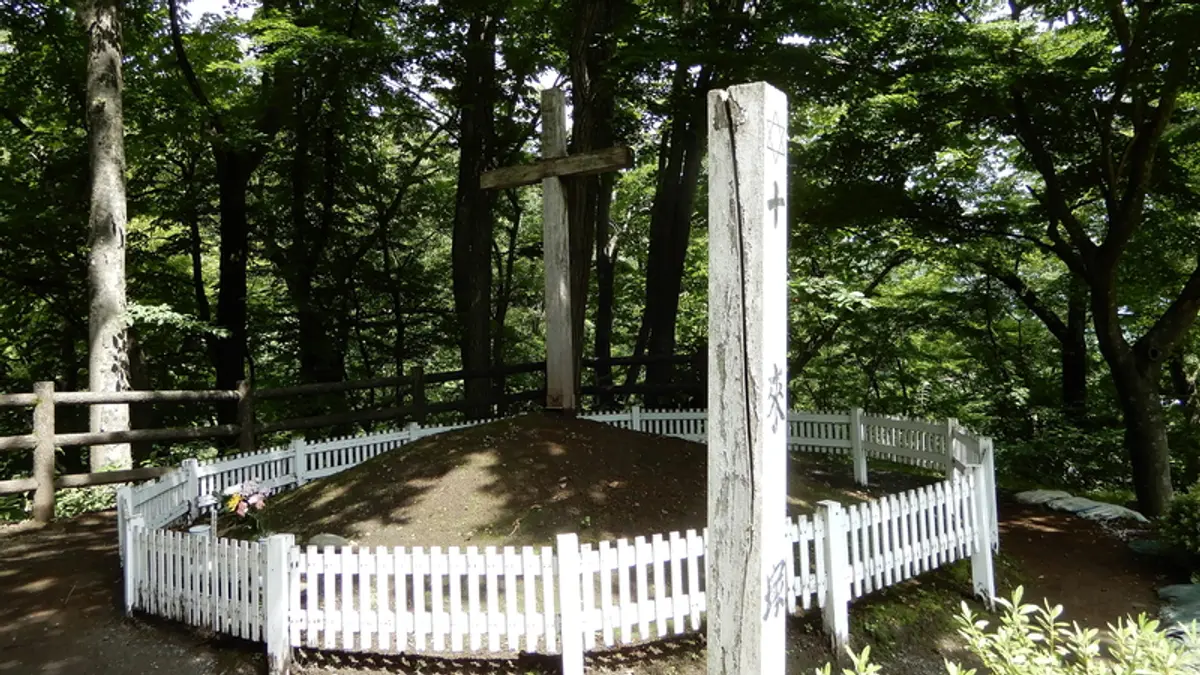
If you travel far enough north in Japan, two stories appear that sound as if they were invented to win an argument.
One says that Minamoto no Yoshitsune, one of Japan's most famous tragic warriors, did not die in Hiraizumi at all. He escaped north, crossed the sea and eventually became Genghis Khan.
The other says that Jesus did not die at Golgotha. His younger brother took his place, Jesus traveled to Japan, settled in what is now Aomori Prefecture and lived there to the age of 106.
Neither story is accepted history.
But both have attached themselves to real places, real landscapes and local traditions. That makes them interesting for a different reason.
Yoshitsune's documented story ends in Hiraizumi
Minamoto no Yoshitsune is not a legendary invention. He was a real 12th-century military commander whose victories helped the Minamoto defeat the Taira.
His later life was much less triumphant.
After falling out with his half-brother Minamoto no Yoritomo, Yoshitsune fled north and eventually found protection in Hiraizumi under the Northern Fujiwara. After the death of Fujiwara no Hidehira, that protection collapsed.
Hiraizumi's official historical chronology records Yoshitsune's suicide in 1189.
That is where the documented story ends.
The legend refuses to stop there
Folklore gives Yoshitsune another route.
By the Edo period, stories had developed in which he survived Hiraizumi and escaped farther north. Along the Sanriku Coast, places in and around Miyako preserve legends that Yoshitsune and his followers passed through or stayed there.
Farther north again, Aomori has its own version of the story. The prefecture's official account of the legend says the tale of Yoshitsune surviving and traveling north was born in the Edo period, and traditions in Sotogahama place him at the northern end of the Tsugaru Peninsula before a crossing to Hokkaido.
The farther the story travels, the less it looks like biography and the more it becomes folklore.
But it still keeps moving.
Then Yoshitsune reaches Mongolia
The biggest leap came much later.
In 1924, Oyabe Zenichiro published a book arguing that Genghis Khan was actually Minamoto no Yoshitsune. The title made the claim directly, and the book became closely associated with the modern version of the theory.
Oyabe did not create the older story that Yoshitsune had escaped north. He took that survival legend much farther.
Historical evidence does not support the identification. Genghis Khan was the Mongol leader Temüjin, whose birth is generally placed in the 1160s, well before Yoshitsune's recorded death in 1189. Modern historical scholarship treats them as separate people.
Still, the legend has an almost irresistible narrative shape.
A tragic Japanese hero disappears instead of dying, keeps traveling beyond the edge of the familiar map and reappears as one of the most famous conquerors in world history.
As history, it does not work.
As a story, it is easy to see why it survived.
A different impossible journey ends in Aomori
Then there is Shingo, a small village in Aomori Prefecture.
According to the local Christ legend, Jesus was not crucified at Golgotha. His younger brother, called Isukiri in the story, died in his place. Jesus escaped, traveled to Japan, eventually settled in the area now known as Shingo, lived as a farmer and died at the age of 106.
Two mounds topped by wooden crosses are presented as the graves connected with Jesus and Isukiri.
The village does not need to be treated as evidence for an alternative history of Christianity. The interest is in the legend itself and in the fact that it became attached to this particular place in northern Japan.
This legend has a surprisingly modern public starting point
Unlike Yoshitsune's northward escape story, the Shingo Christ legend has a fairly clear moment when it entered the public record.
In 1935, Takenouchi Kiyomaro and an ancient-history researcher came to the village, then called Herai, and identified two mounds as the graves described in the so-called Takenouchi Documents.
Those documents are generally treated as apocryphal, and the claim did not turn Shingo into a forgotten chapter of biblical history.
What it did create was a remarkably durable local legend.
That difference matters.
Yoshitsune's story grew northward over centuries before being stretched all the way to Mongolia. The Christ story in Shingo appears publicly in the 1930s and then becomes part of the identity of the village.
The stories travel in opposite directions
Put the two legends next to each other and they move in almost opposite directions.
Yoshitsune begins in documented Japanese history. His legend then carries him outward: from Hiraizumi through northern Japan, across the sea and eventually all the way to Mongolia.
The Shingo story does the reverse. It takes one of the central figures of a world religion and pulls him inward, from Golgotha to a small mountain village in Aomori.
One turns a Japanese warrior into a figure of world history.
The other turns a figure of world history into a resident of rural Japan.
That symmetry is more interesting than trying to prove either story true.
Why do stories like these stick?
Their appeal does not depend on literal belief.
A legend can give a landscape a second layer. A temple, a coastline, a village or an ordinary-looking mound becomes connected to a story much larger than the place itself.
In Hiraizumi, the historical Yoshitsune is already part of the landscape.
Along the Sanriku Coast and farther north, folklore keeps him moving.
In Shingo, a pair of quiet mounds connects a small Aomori village to one of the most familiar stories in the world.
The geography is real even when the story is not.
You do not have to choose between history and legend
The most interesting way to approach these stories is not to treat legend as a rival version of history.
History tells us where the evidence leads.
Folklore tells us what people kept imagining after the evidence ran out.
For Yoshitsune, the documented trail ends in Hiraizumi in 1189. The legend sends him north and eventually turns him into Genghis Khan.
For Shingo, the public story of Christ's grave can be traced to 1935, but the village has continued to live with that extraordinary tale ever since.
Sometimes a story is worth traveling for not because you believe it.
It is worth traveling for because it makes you look twice at a place.