Once Upon a Time in Edo: The Megacity of “Closed” Japan
September 28, 2026
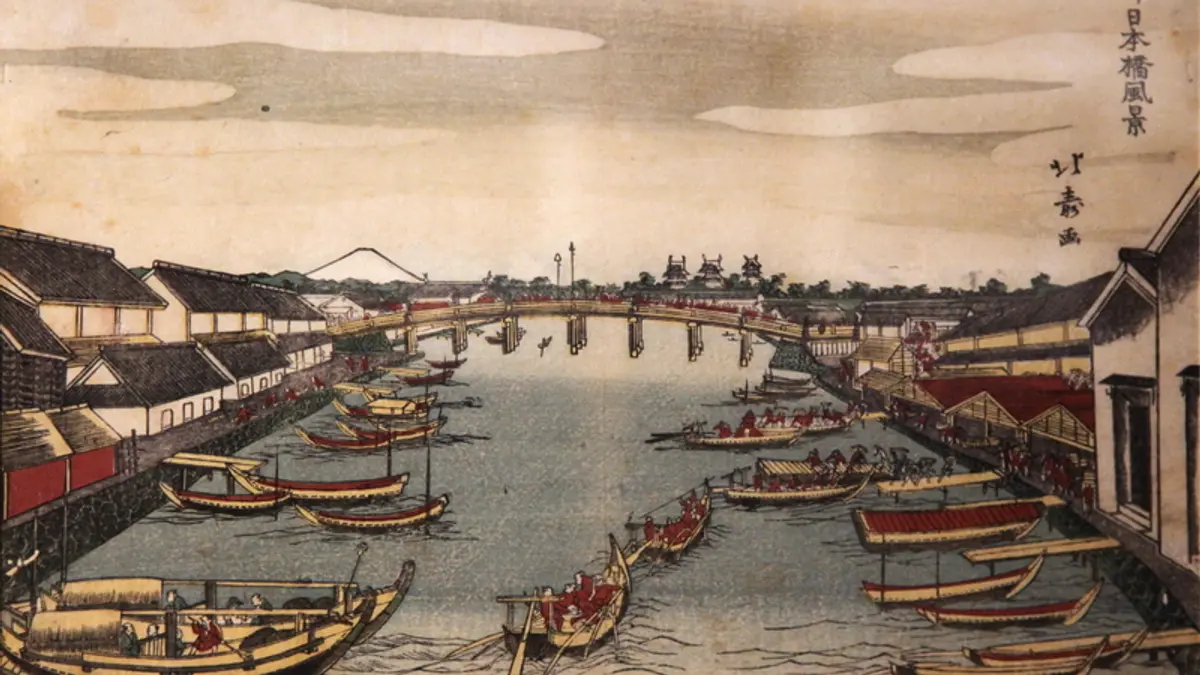
Once upon a time, during the period often described as Japan’s “closed country” era, one of the world’s great cities was already taking shape.
It was Edo—the city we now call Tokyo.
By the early 18th century, Edo had grown to an extraordinary size. Population estimates vary, but some put its population at more than one million.
That may seem surprising.
There were no railways. No trucks. No refrigeration. No electricity. International contact was restricted and carefully controlled.
And yet Edo had become a megacity.
Which raises a simple question:
How did a city this enormous keep itself supplied?
One of the World’s Great Cities
Supporting a city of this size required an enormous and continuous flow of goods.
Rice had to arrive.
Fish had to arrive.
Salt, sake, soy sauce, cooking oil, firewood, charcoal, lumber, textiles, and paper all had to arrive.
And they had to keep arriving.
A megacity is not simply a place where many people live. It is a place capable of supplying those people every single day.
Long before Tokyo had railway terminals, expressways, container ports, and distribution centers, Edo had already developed another solution.
How Do You Feed a Megacity Without Trucks?
Edo depended on an extensive network of coastal shipping, rivers, canals, roads, warehouses, markets, wholesalers, and merchants.
Some supplies came from the agricultural areas surrounding the city. Others traveled much farther.
Osaka was one of Japan’s great commercial and distribution centers, gathering products from regions across the country. Regular cargo shipping developed between Osaka and Edo, including the higaki-kaisen and taru-kaisen services.
Rice, sake, oil, textiles, and many other goods traveled through networks connecting producing regions, ports, commercial centers, and finally Edo.
The result was something surprisingly familiar.
Edo was not simply a large collection of people.
It was the center of an enormous system for moving things.
The Sea Was Edo’s Highway
Japan is mountainous, and moving large quantities of heavy cargo overland was difficult and expensive.
Water offered another solution.
Ships could carry large quantities of goods along the coast. After reaching Edo, cargo could continue along rivers and canals toward markets, warehouses, and neighborhoods inside the city.
Waterways were therefore not just scenery.
They were infrastructure.
This is worth remembering when looking at old images of Edo filled with boats.
Those boats were not merely picturesque details of an old city.
They were part of the machinery that kept the megacity alive.
Then the Cargo Entered the City
Getting goods to Edo was only half the problem.
They still had to reach the people who needed them.
Wharves and riverside districts became transfer points. Warehouses stored goods. Wholesalers divided large shipments. Merchants and peddlers carried products farther into the city.
The famous fish market around Nihonbashi is a good example.
Seafood arriving from Edo Bay and elsewhere passed through wholesalers, intermediaries, and peddlers before reaching consumers. The fish market spread along the Nihonbashi River and became one of the busiest commercial spaces in Edo.
The process looked very different from modern logistics.
The problem was remarkably similar.
A huge city needed a system that could take large shipments, divide them into smaller flows, and eventually deliver them to individual neighborhoods and households.
Why Nihonbashi Mattered
For travelers today, Nihonbashi may look like one more bridge surrounded by office buildings.
Historically, it was much more than that.
Nihonbashi became the starting point of the Five Highways, including the Tokaido, and distances along those routes were measured from here. Around the bridge were markets, shops, roads, waterways, government offices, and merchants.
Different kinds of movement met here.
People traveled along the major roads.
Merchants moved goods through the streets.
Boats carried cargo through the waterways below.
Nihonbashi was not simply a landmark.
It stood inside one of the systems that made Edo work.
Three Views of the Same City
Look at Nihonbashi across three different eras, and Tokyo’s transportation history seems to unfold in front of you.
In the Edo period, people and goods crossed the bridge while boats moved cargo through the waterways below.
By the mid-20th century, streetcars and automobiles had become part of the scene.
Today, road traffic passes through Nihonbashi while an expressway runs directly above it.
The infrastructure changed dramatically.
The basic urban challenge did not.
A huge city still had to move people and goods every day.
A City of Consumers
One reason Edo became so large was its political role.
Under the sankin-kotai system of alternate attendance, daimyo regularly traveled between their domains and Edo. Their residences, retainers, servants, and the goods that accompanied them contributed to the city’s enormous population and demand.
Political power concentrated a huge number of consumers in one place.
That demand connected Edo with regions far beyond the city.
And transportation made that concentration sustainable.
So How “Closed” Was Japan?
This brings us back to the apparent contradiction at the beginning of the story.
Edo-period Japan is often described in English simply as a “closed country.”
But imagine a country in which almost nothing moved.
Could it support a city of this size?
The word “closed” can be misleading if taken too literally.
Japan’s international contacts were restricted and carefully controlled, but the country itself was anything but motionless. Within Japan, goods, people, money, and information circulated through extensive networks of roads, coastal shipping routes, ports, post towns, castle towns, and commercial centers.
Edo was only one part of that system.
Osaka was a major center of commerce and distribution. Kyoto remained an important center of culture and craft production. Ports and castle towns connected regional economies to larger networks.
So perhaps the surprising thing is not simply that Edo became enormous during the so-called “closed country” era.
It is that the existence of Edo itself reveals just how much movement was taking place inside Japan.
The Network Changed. The Megacity Remained.
Modern Tokyo looks completely different from Edo.
Wooden cargo ships have been replaced by container vessels and trucks. Streetcars have largely given way to trains, subways, buses, and automobiles. Wharves and warehouses have been joined by distribution centers, airports, expressways, and enormous railway terminals.
Even the fish market that once flourished beside Nihonbashi eventually moved to Tsukiji after the Great Kanto Earthquake.
The technology changed.
The scale changed.
The basic problem did not.
Millions of people still need food, energy, materials, and countless other things brought into the city every day.
Tokyo Was a Megacity Before It Was Tokyo
Once upon a time, long before the modern Tokyo skyline existed, Edo was already one of the world’s great cities.
It grew during an era remembered for restrictions on international contact, yet it depended on extraordinary movement within Japan.
Ships crossed the coasts.
Cargo moved through rivers and canals.
Roads connected towns and regions.
Markets and merchants distributed goods through the city.
And at places such as Nihonbashi, those networks came together.
Over the centuries, ships gave way to trains and trucks. Wharves were joined by stations, highways, ports, and logistics centers. Nihonbashi changed from a bridge surrounded by busy waterways, to a streetcar corridor, to a road beneath an expressway.
The network changed. The megacity remained.
Perhaps that is one of the most interesting ways to look at Tokyo today.
Not simply as an enormous modern city, but as a city that has been solving the problem of moving people and goods on a massive scale for more than three centuries.