Where to Go in North Kanto: Nikko, Nasu, Kusatsu, Minakami and Ibaraki
September 19, 2026
North Kanto consists of Tochigi, Gunma and Ibaraki.
All three are close enough to Tokyo to be accessible, but they are not one kind of destination.
Tochigi combines world-famous heritage with mountains and resort areas. Gunma is one of Japan's strongest regions for hot springs and outdoor travel. Ibaraki faces the Pacific and combines gardens, seasonal flowers, mountains, science and coastal towns.
Rather than trying to “see North Kanto,” choose the part that matches your reason for leaving Tokyo.
Nikko: The first choice for major history
Nikko is the obvious starting point for many international travelers.
The UNESCO World Heritage property “Shrines and Temples of Nikko” contains 103 buildings associated with Toshogu, Futarasan Shrine and Rinnoji. Beyond the heritage area, the wider Nikko region includes Lake Chuzenji, Kegon Falls, Senjogahara and Oku-Nikko. (japan.travel)
The main heritage area can be visited as a day trip from Tokyo.
But Nikko extends far beyond the temples.
If you also want lakes, waterfalls, wetlands, hiking or Oku-Nikko's hot springs, one night becomes much more attractive.
Trying to fit both the World Heritage area and deeper Oku-Nikko into a short day can turn one of Japan's most rewarding regions into a transport exercise.
Utsunomiya: A useful stop rather than only a transfer
Many travelers pass through Utsunomiya on the way to Nikko or northern Tochigi.
The city is particularly known for gyoza and works well as a meal stop or short urban break during a wider Tochigi trip.
You do not necessarily need a whole day here.
But that is precisely why it can be useful.
Nasu: A resort in the mountains
Nasu offers a completely different experience from Nikko.
The Tohoku Shinkansen reaches Nasushiobara from Tokyo in about 70 minutes, with local buses continuing toward destinations in the Nasu Highlands. The region includes volcanic mountain scenery, hot springs, hiking and winter activities. (japan.travel)
Nasu is better understood as an area where you stay rather than as a single attraction you visit.
Choose Nasu if you want a mountain hotel, onsen, outdoor scenery and a slower schedule.
Kusatsu: Travel there for the onsen town itself
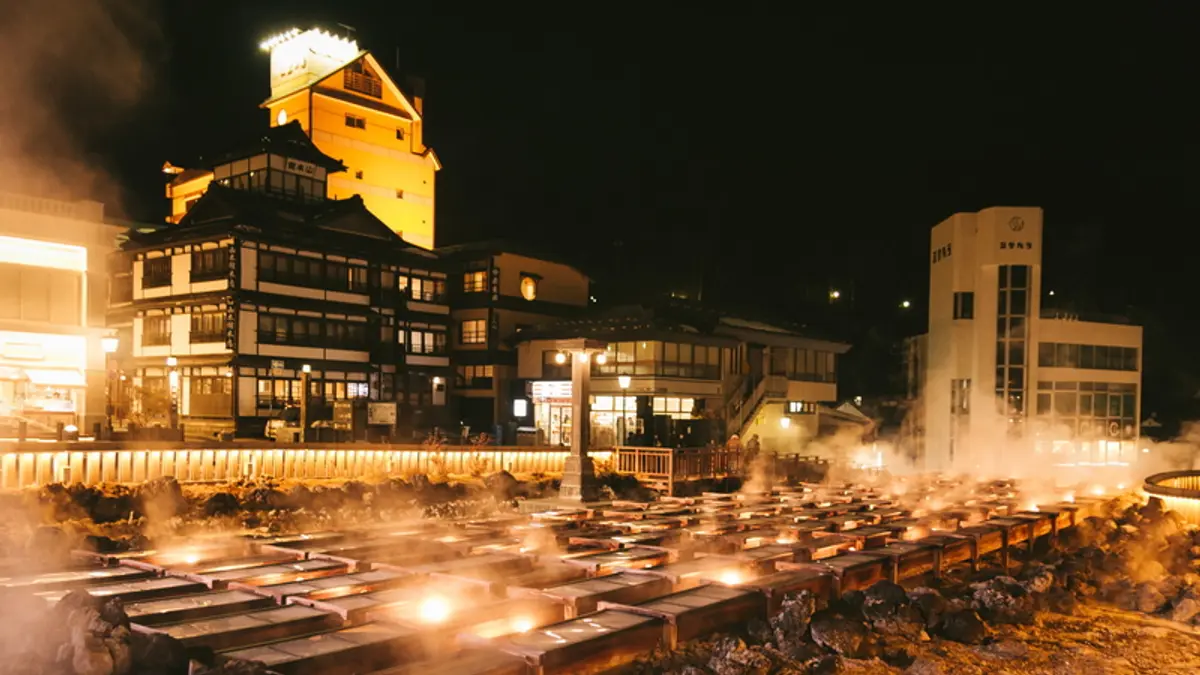
Kusatsu is one of Japan's best-known hot-spring resorts.
Yubatake sits at the center of town, surrounded by inns, bath facilities, shops and restaurants. From Naganohara-Kusatsuguchi Station, the bus to Kusatsu Onsen normally takes around 25 minutes. (visit-gunma.jp)
Kusatsu is a destination where staying overnight matters.
Arriving, taking one quick bath and immediately leaving rather misses the point.
Spend the evening walking around Yubatake and enjoy the difference between the busy daytime town and the quieter hours after day visitors leave.
Ikaho: A compact hot-spring town
Ikaho offers another style of Gunma onsen.
The town rises around a long stone staircase lined with inns, shops and restaurants. Nearby Mt. Haruna and Lake Haruna make it possible to combine the onsen town with mountain scenery.
From Shibukawa Station, buses to the stone-step area take around 25 minutes. (visit-gunma.jp)
Compared with Kusatsu, Ikaho is compact and easy to incorporate into a wider Gunma itinerary.
Minakami: Go there to do something
Minakami suits travelers who want outdoor activity rather than a dense list of monuments.
The area is associated with skiing, rafting, hiking, mountain scenery and onsen. Jomo-Kogen Station on the Joetsu Shinkansen is one of the main gateways, with buses continuing toward Minakami and surrounding areas.
Winter brings snow sports and hot springs.
Warmer months bring hiking, river activities and access toward the mountains around Tanigawa.
Choose Minakami when you want to move, not simply look.
Mito and Kairakuen: Gardens and history
Ibaraki changes the character of the journey again.
Mito is about 70 minutes from Tokyo by Joban Line limited express. Its best-known attraction is Kairakuen, established by Tokugawa Nariaki in 1842 and famous for around 3,000 plum trees representing roughly 100 varieties. (japan.travel)
Mito suits travelers who prefer history, landscape design and a city base to mountain resorts.
Hitachi Seaside Park: Go when the season is right
Hitachi Seaside Park is one of Ibaraki's most recognizable modern attractions.
The park is famous for large seasonal flower displays, especially blue nemophila in spring and kochia in autumn. Tokyo is directly connected with nearby Katsuta by Joban Line limited express services, and buses continue from Katsuta to the park.
This is one destination where checking current conditions matters.
Flowers follow nature, not your flight schedule.
The exact peak changes each year, so check the park's current flowering information before deciding on the day.
Oarai: Add the Pacific coast
Oarai and nearby Hitachinaka add a coastal side to Ibaraki.
The area has beaches, fishing ports, seafood and Pacific scenery. Oarai can be reached from Mito using the Kashima Rinkai Railway. (japan.travel)
If you are already traveling toward Mito or Hitachi Seaside Park, Oarai can turn a single-attraction excursion into a broader trip through central Ibaraki.
Tsukuba: Science and mountains on the same trip
Tsukuba is one of North Kanto's most unusual destinations.
The city is one of Japan's major research centers and home to JAXA's Tsukuba Space Center. The Space Dome can be visited as an exhibition area, while separate guided tours require advance arrangements.
Nearby Mt. Tsukuba provides a completely different experience, with hiking routes, a cable car and ropeway.
A science-oriented morning and a mountain-oriented afternoon can genuinely belong to the same regional trip.
How should you divide your time?
Nikko can be a day trip if you focus on the World Heritage area; stay overnight for Oku-Nikko.
Nasu, Kusatsu and Minakami are generally more rewarding with at least one night.
Ikaho can work either as a day trip or an overnight stop.
Mito works well as a day trip, while combining Mito, Hitachinaka and Oarai can justify a night in Ibaraki.
Tsukuba is one of the easier North Kanto excursions from Tokyo.
Which North Kanto destination should you choose?
Choose Nikko for major history and sacred landscapes.
Choose Nasu for a mountain resort.
Choose Kusatsu or Ikaho when hot springs are the main purpose of the trip.
Choose Minakami for active outdoor travel.
Choose Mito for history and gardens.
Choose Hitachinaka and Oarai for seasonal flowers and the Pacific coast.
Choose Tsukuba for science, Mt. Tsukuba, or something completely different from the standard Japan itinerary.
North Kanto makes much more sense when you stop thinking of it as one destination.
Choose by purpose, and the region becomes remarkably varied.
Related planning guides
Where to stay
Planning to stay overnight? Find accommodation in:
Related Routes
- Akihabara → Tsukuba
- Jomo-Kogen → Minakami
- Katsuta → Hitachi Seaside Park
- Mito → Oarai
- Naganoharakusatsuguchi → Kusatsu Onsen
- Nasushiobara → Nasu Yumoto Onsen
- Shibukawa → Ishidangaiguchi
- Tokyo → Jomo-Kogen
- Tokyo → Katsuta
- Tokyo → Mito
- Tokyo → Naganoharakusatsuguchi
- Tokyo → Nasushiobara
- Tokyo → Tobu-Nikko
- Tokyo → Utsunomiya
- Tsukuba → Mt. Tsukuba