Where to Go in Yamaguchi: Between Two Seas
September 24, 2026
Yamaguchi sits at the western end of Honshu, between the Seto Inland Sea and the Sea of Japan.
The two coasts give the prefecture very different characters. On the southern side, Iwakuni and Shin-Yamaguchi lie close to the main Sanyo transport corridor, with fast connections toward Hiroshima and other cities along western Honshu. To the north, Hagi and Nagato face the Sea of Japan, where historic towns, coastal landscapes, and longer local journeys create a different pace of travel.
Between the two are inland destinations such as Yamaguchi city and Akiyoshidai. At the western end of the prefecture, the land narrows toward Shimonoseki and the Kanmon Strait, with Kyushu immediately across the water.
There is no need to cover both coasts in one trip. A shorter visit can stay close to the well-connected Sanyo side, while adding Hagi or the northern coast reveals a very different side of Yamaguchi.
For travelers using public transport, the useful question is not how much of the prefecture can be covered, but which places deserve more time and which work naturally together.
Iwakuni: Easy to Combine with Hiroshima
At the eastern side of Yamaguchi, Iwakuni is closely connected with Hiroshima.
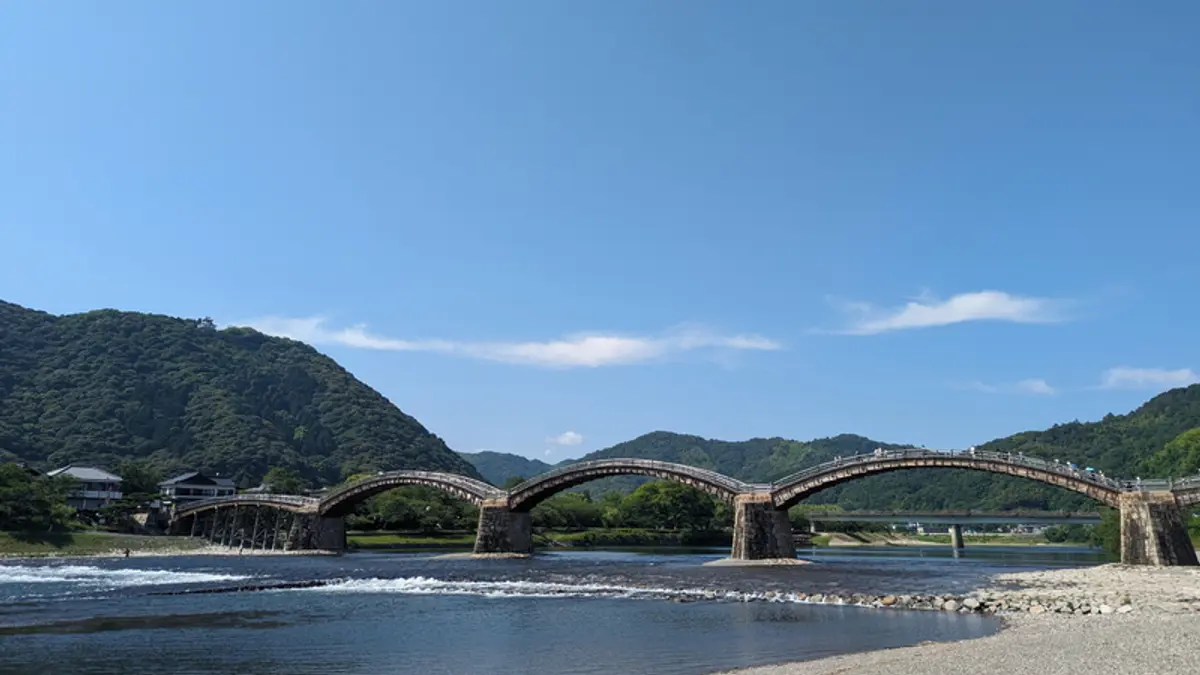
Its best-known sight is Kintaikyo Bridge, the five-arched wooden bridge crossing the Nishiki River. Across the bridge are Kikko Park and the ropeway leading toward Iwakuni Castle, allowing the main sights to be explored within the same area.
Buses connect Kintaikyo with both Iwakuni Station and Shin-Iwakuni Station, making the area practical to reach without a car.
Because of its location, Iwakuni does not necessarily require an overnight stay. It can be visited from Hiroshima as a day trip or included when spending more time in eastern Yamaguchi.
That flexibility makes Iwakuni one of the easiest places in the prefecture to combine with a trip along the Sanyo corridor.
Yamaguchi and Shin-Yamaguchi: City and Transport Gateway
Yamaguchi city lies inland from the main Sanyo railway corridor.
The city has a quieter scale than the larger urban centers along the Seto Inland Sea. Rurikoji Temple and its five-story pagoda are among its best-known sights, while the surrounding streets offer a reason to leave the faster Sanyo corridor and spend some time inland.
For public-transport travelers, nearby Shin-Yamaguchi plays a different but equally useful role.
The Sanyo Shinkansen stops at Shin-Yamaguchi, and buses and local trains connect the station with Yamaguchi city and destinations farther inland and north.
The two places therefore complement each other. Yamaguchi is the place to explore, while Shin-Yamaguchi provides many of the connections that make this part of the prefecture practical to visit.
Akiyoshidai and Akiyoshido: Going Inland
Northwest of the Sanyo corridor lies one of Yamaguchi’s most distinctive landscapes.
Akiyoshidai is a broad karst plateau of grassland and exposed limestone. Beneath it, Akiyoshido extends through one of Japan’s largest limestone cave systems.
This is also a useful example of how travel in Yamaguchi changes once you leave the main railway corridor. There is no railway station beside the plateau or cave, so buses become an important part of the journey.
Direct bus connections from Shin-Yamaguchi make the area possible to visit by public transport, but Akiyoshidai is better treated as an outing in its own right rather than something to squeeze between unrelated rail journeys.
For travelers interested in natural scenery, it provides a very different experience from the cities along the Sanyo side.
Hagi: A Different Side of Yamaguchi
Cross the mountains toward the Sea of Japan and the character of Yamaguchi changes.
Hagi is one of the clearest reasons to visit the northern side of the prefecture. The former castle town preserves historic streets, samurai residences, old merchant buildings, and a townscape that rewards exploring on foot.
Its location also gives Hagi two different connections.
For travelers coming through the Sanin region from western Shimane, Hagi fits naturally with the Sea of Japan side of western Honshu. From the Sanyo side, direct buses from Shin-Yamaguchi cross the prefecture to Hagi, providing a practical alternative to approaching only by rail.
Within Hagi, local buses connect the main stations and bus center with major sightseeing areas.
Hagi is less suited to a brief visit of only a few hours than Iwakuni. The historic areas are spread across the city, and travelers especially interested in old townscapes may find an overnight stay worthwhile.
Nagato and Senzaki: The Sea of Japan Coast
West of Hagi, the Sea of Japan coast continues toward Nagato.
For travelers using public transport, Senzaki provides one of the more practical ways to experience this part of northern Yamaguchi. The port area can be explored on foot, and boats from Senzaki provide views of the coastline around Omijima.
This part of the prefecture requires more attention to transport than the Sanyo side. Rail services in the wider Nagato area have been affected by long-term suspensions, while buses and direct services from Shin-Yamaguchi provide important alternatives.
Some of Nagato’s well-known coastal sights are not served conveniently by regular public transport. Rather than trying to cover the entire coast, travelers without a car can focus on places such as Senzaki and Omijima that fit more naturally into a public-transport trip.
The slower connections are part of what distinguishes northern Yamaguchi from the faster railway corridor on the Seto Inland Sea side.
Shimonoseki: At the Western Edge of Honshu
At the western end of Yamaguchi, Shimonoseki faces the Kanmon Strait.
Around Karato, the waterfront looks directly across the narrow channel toward Kyushu. Karato Market is known for seafood, while ships passing through the strait make the water itself an important part of the landscape.
The area is easily reached by bus from Shimonoseki Station, so there is no need to treat Shimonoseki only as a railway connection between Honshu and Kyushu.
The geography becomes even more unusual near the Kanmon Strait. Railways pass beneath the water, passenger boats cross between Karato and Mojiko, and the Kanmon Pedestrian Tunnel allows people to walk beneath the strait between Honshu and Kyushu.
For a Yamaguchi trip, there is no need to follow those connections farther into Kyushu. What matters here is the setting: after traveling through a prefecture shaped by both the Seto Inland Sea and the Sea of Japan, Shimonoseki brings those geographies together at the narrow waterway separating Honshu from Kyushu.
Where to stay
Planning to stay overnight? Find accommodation in:
Related Routes
- Higashi-Hagi → Nagatoshi
- Hiroshima → Iwakuni
- Hiroshima → Shin-Iwakuni
- Hiroshima → Shin-Yamaguchi
- Iwakuni → Kintaikyo
- Karato Pier → Mojiko Pier
- Kokura → Shimonoseki
- Masuda → Higashi-Hagi
- Nagatoshi → Senzakitchen
- Shimonoseki → Karato Pier
- Shin-Iwakuni → Kintaikyo
- Shin-Osaka → Hiroshima
- Shin-Yamaguchi → Akiyoshido
- Shin-Yamaguchi → Higashi-Hagi
- Shin-Yamaguchi → Senzakitchen
- Shin-Yamaguchi → Shimonoseki
- Shin-Yamaguchi → Yamaguchi