One Week, Three Very Different Festivals: Aomori Nebuta, Akita Kanto and Sendai Tanabata
September 18, 2026
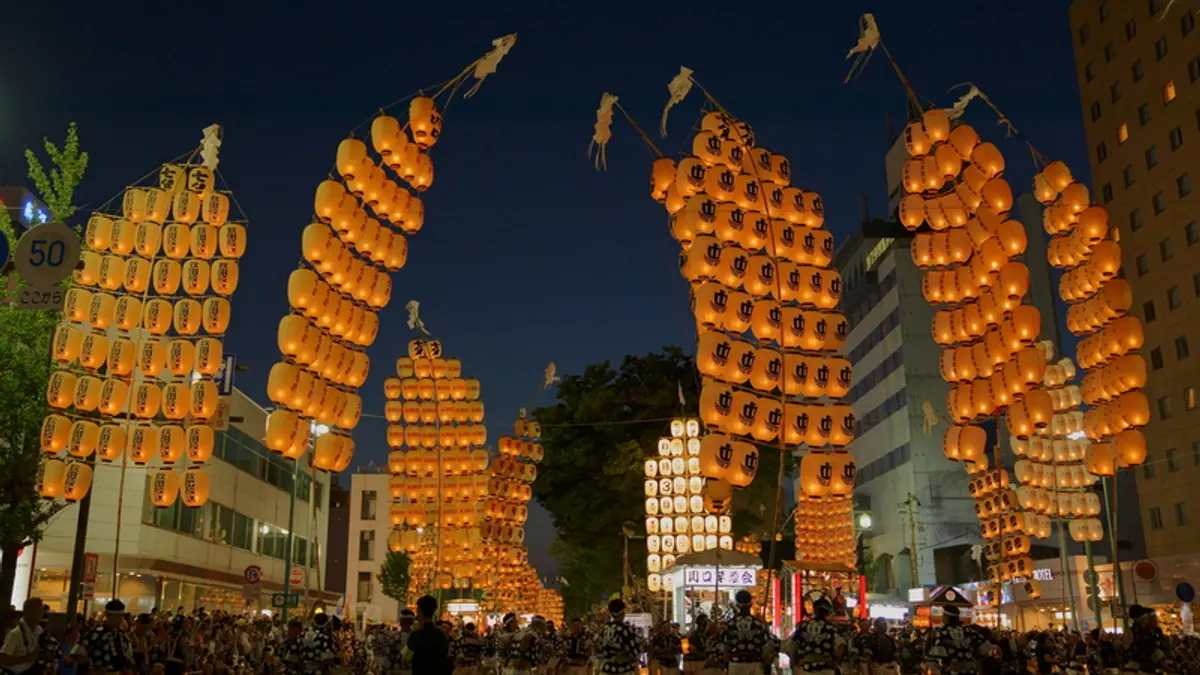
Every August, three of Tohoku's best-known festivals take place within the same seven-day stretch.
Aomori Nebuta runs from August 2 to 7.
Akita Kanto runs from August 3 to 6.
Sendai Tanabata runs from August 6 to 8.
They are commonly grouped as Tohoku's three great summer festivals, and the dates make it possible to see all three during one journey. JNTO even presents them as a single summer festival circuit.
But putting them in one group creates the wrong expectation.
They barely resemble one another.
That is exactly why seeing them together works.
Aomori Nebuta moves
Aomori Nebuta is the most immediately theatrical of the three.
Huge illuminated floats depicting warriors, historical figures and scenes from traditional stories move through the city accompanied by musicians and Haneto dancers. A full-size Nebuta can be about 9 meters wide and 5 meters high, so the scale is part of the experience before the float even begins to move.
From August 2 to 6, the main processions take place at night. On August 7, the schedule changes to a daytime procession, followed in the evening by a marine procession in Aomori Bay and fireworks.
The festival's origins are not known with certainty. Official explanations generally describe Nebuta as having developed from a combination of Tanabata lantern customs and older local traditions in the Tsugaru region. Paper, bamboo and candles gradually became increasingly elaborate lanterns and, eventually, the giant illuminated figures seen today.
That uncertainty is worth keeping. Festivals this old rarely begin on a single identifiable day.
Nebuta feels less like an object on display than an artwork that only becomes complete once it starts moving.
Akita Kanto balances
Akita Kanto creates its drama in a completely different way.
Long bamboo poles carry rows of paper lanterns high above the performers. The largest Owaka poles are about 12 meters tall, weigh around 50 kilograms and carry 46 lanterns.
Performers balance the poles on their palms, foreheads, shoulders and hips, adding bamboo extensions as the display continues.
At the festival, around 280 kanto poles and roughly 10,000 lanterns can fill the streets.
The tension comes from watching the bamboo flex, the lanterns respond to the wind and the performer make constant small corrections to keep the entire structure upright.
Kanto is generally linked to neburi nagashi, a summer custom associated with driving away illness, impurity and drowsiness. Written records from the late 18th century already describe long poles carrying lights.
If Nebuta is about movement through the city, Kanto is about keeping something apparently impossible in the air.
Sendai Tanabata hangs above you
Sendai Tanabata changes the scale again.
There are no giant warrior figures moving through the streets and no 12-meter poles balanced on a performer's body.
Instead, you walk beneath paper.
Large handmade bamboo decorations and long streamers hang above the central shopping streets, especially from the area around Sendai Station into the city's covered arcades.
The tradition in Sendai is commonly traced to the time of Date Masamune. The modern festival is held from August 6 to 8, one month later than July 7, bringing it closer to the season of the older lunar calendar.
The decorations take months to prepare and are newly handmade each year.
Sendai Tanabata is not mainly a parade that passes in front of you.
The city has been decorated for you to walk through.
They share a calendar, not a form
Put the three festivals side by side and the differences are almost the entire point.
Aomori fills the night with giant illuminated figures, music and dancers.
Akita turns thousands of lanterns into an exercise in balance and control.
Sendai transforms ordinary shopping streets with paper and bamboo.
They take place in the same region and within almost the same week, but they offer three very different answers to the question of what a city can become during summer.
Can you really see all three?
Yes.
The dates overlap in a way that makes a three-festival journey possible, and JNTO promotes an itinerary linking them.
That does not mean it is wise to improvise the trip at the last minute.
These are major events. Transport and accommodation can become busy, and the festival dates themselves overlap. Decide which festival matters most to you, secure that part of the trip first, and then fit the other two around it.
There is also no requirement to collect all three.
If giant illuminated floats are what you want to see, make Aomori the focus.
If the physical skill of the performers is the attraction, give Akita priority.
If you prefer to explore a decorated city at your own pace, Sendai offers a completely different experience.
One week, three versions of a Tohoku summer
Calling Aomori Nebuta, Akita Kanto and Sendai Tanabata the three great summer festivals of Tohoku makes them sound like variations on one idea.
They are not.
One night you can watch giant illuminated figures move through Aomori.
On another, thousands of lanterns rise above the streets of Akita.
Then in Sendai, the festival hangs overhead as you walk beneath it.
Same region.
Same week.
Three very different ways to turn a city into a festival.