Gujo Hachiman — A Little Kyoto Shaped by Water and Castle-Town Traditions
October 17, 2026
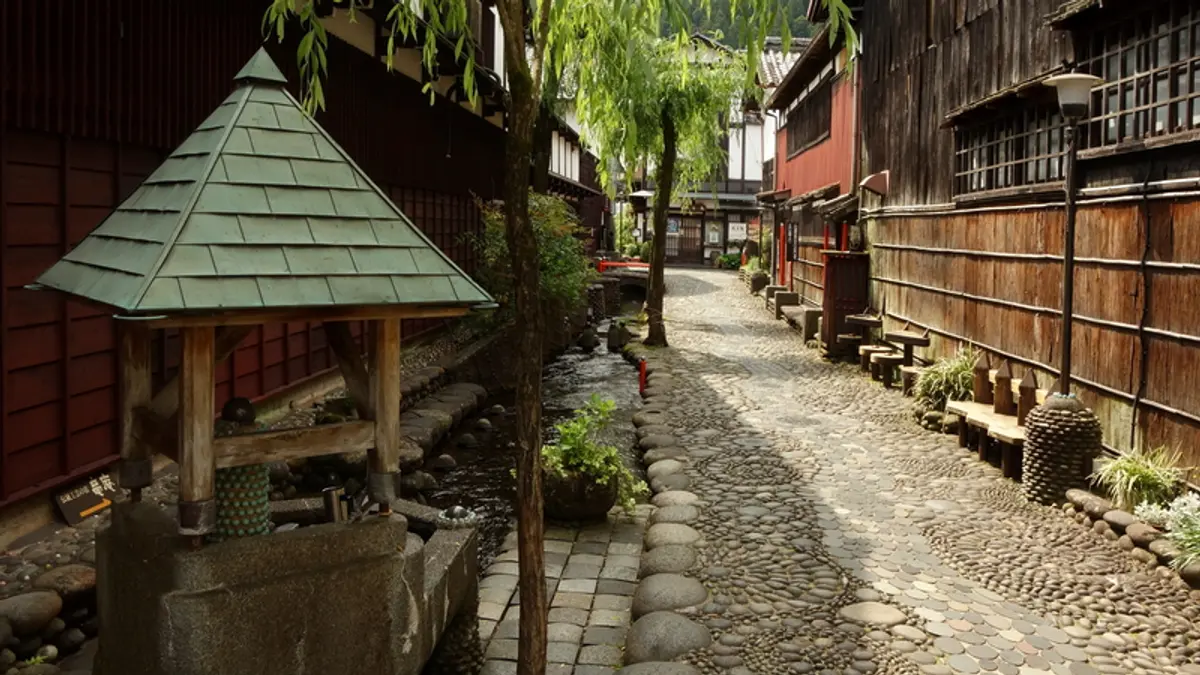
In the mountains of central Gifu Prefecture lies Gujo Hachiman, a historic castle town where narrow streets, flowing waterways, and centuries-old traditions remain part of everyday life.
Often described as one of Japan’s “Little Kyoto” towns, Gujo Hachiman offers something different from the former imperial capital. Rather than grand temples and famous gardens, its appeal lies in the intimate scale of its streets, the sound of running water, and the customs preserved by generations of local residents.
The town is especially famous for Gujo Odori, a traditional dance festival that brings residents and visitors together on summer nights. Yet beyond the festival, Gujo Hachiman has a quieter story to tell: one of a castle town shaped by its landscape, rebuilt after disaster, and sustained by a distinctive relationship with water.
Why Gujo Hachiman Is Called a Little Kyoto
The expression “Little Kyoto” is commonly used for Japanese towns whose historic streets, traditional architecture, or cultural atmosphere recall aspects of Kyoto.
Gujo Hachiman fits this description through its preserved castle-town setting. Traditional wooden buildings stand along narrow streets, while temples, old merchant neighborhoods, and the castle overlooking the town contribute to a landscape that feels closely connected to Japan’s past.
Its resemblance to Kyoto should not, however, be understood as evidence that the town was deliberately designed as a copy of the ancient capital.
Gujo Hachiman developed as a regional castle town with its own history, geography, and traditions. Its character emerged from the surrounding mountains and rivers, the organization of its samurai and merchant districts, and the daily lives of the people who inhabited them.
What makes Gujo Hachiman a Little Kyoto is therefore not an exact architectural resemblance, but the experience of walking through a town where historical streets and living traditions remain closely connected.
A Castle Town Beneath the Mountains
The origins of Gujo Hachiman Castle date to 1559, when Endo Morikazu established a fortification on the hill overlooking the area.
The castle subsequently became associated with the development of the town below, which served as the political and administrative center of the surrounding domain during the Edo period.
Like many Japanese castles, Gujo Hachiman Castle did not survive the changes that followed the end of feudal rule. Its buildings were dismantled in the early Meiji period.
The castle keep visible today is not an original structure from the feudal era. It is a wooden reconstruction built in 1933, designed to evoke the appearance of a traditional Japanese castle.
Standing above the town, the reconstructed keep provides a sweeping view of the streets, rivers, and mountains that shaped Gujo Hachiman’s development.
From this vantage point, the relationship between the castle and the settlement below becomes particularly clear.
Kitamachi — Streets That Preserve the Castle Town
One of the best places to explore Gujo Hachiman’s historical character is Kitamachi, the northern part of the old castle town.
Its streets include areas historically associated with samurai residences and merchant or artisan households.
Yanagimachi formed part of the former samurai district, while Shokuninmachi and Kajiyamachi developed as neighborhoods connected with craftspeople and merchants. Nearby Tonomachi also recalls the town’s samurai history.
These distinctions are still reflected in the arrangement of streets and the character of the buildings.
However, the townscape is not simply a collection of untouched Edo-period houses.
A major fire in 1919 destroyed much of northern Gujo Hachiman. During the subsequent reconstruction, townhouses were built again, and the historic street pattern remained an important part of the area’s character.
The result is a historic district that reflects both the original organization of the castle town and the efforts of later generations to rebuild it.
In December 2012, approximately 14.1 hectares of Kitamachi were designated a National Important Preservation District for Groups of Traditional Buildings.
The designation recognizes not only the buildings but also their relationship with the surrounding landscape and the waterways that continue to define the neighborhood.
A Town Where Water Is Part of Daily Life
Water is one of Gujo Hachiman’s most distinctive features.
The town developed near the meeting of rivers, and its streets contain a network of channels that have long helped residents make use of flowing water.
In some neighborhoods, water runs beside traditional houses and beneath small bridges. Elsewhere, carefully maintained water facilities reveal how residents adapted their surroundings to practical needs.
The town is known for mizubune, traditional water-use structures that separate water for different purposes. They illustrate an approach to daily life in which clean water was valued, shared, and managed within the community.
Waterways were not merely decorative features added to make the streets attractive. They formed part of the town’s working infrastructure.
Today, these channels are also among the most memorable elements of a walk through Gujo Hachiman.
Their presence gives the town a distinctive rhythm, connecting the historic streets with the rivers and mountains beyond.
Sogisui — A Spring with a Literary Tradition
Among Gujo Hachiman’s celebrated water sources is Sogisui, also known as Hakuunsui.
The spring is associated with Iio Sogi, a prominent master of linked-verse poetry during the Muromachi period.
According to local tradition, Sogi used the spring during his visits to the region. Another account connects the site with his departure after receiving instruction in classical Japanese poetry from To Tsuneyori.
These stories belong to the cultural history of the spring, although their details should be understood as traditions rather than independently established historical events.
Sogisui was selected for Japan’s original list of 100 Famous Waters in 1985.
The spring remains a symbol of the town’s relationship with water and of the literary traditions associated with the region.
Gujo Odori — A Festival That Belongs to Everyone
Gujo Hachiman is perhaps best known for Gujo Odori, one of Japan’s most celebrated traditional dance festivals.
Held over a series of summer evenings, the festival transforms streets and public spaces into gathering places for dancers.
Unlike performances in which spectators remain separate from the participants, Gujo Odori is widely known as a dance that visitors can join.
Residents and travelers form circles and dance together, following melodies and movements passed down through generations.
Local tradition traces the development of the festival to efforts by the domain’s rulers to encourage harmony among the population during the early Edo period. The precise history of its origins, however, is more complex than a single founding event.
The festival includes ten traditional dances, each with its own rhythm and character.
Its most famous nights are the Tetsuya Odori, or all-night dances, traditionally held from August 13 through August 16.
During these evenings, dancing continues until the early morning.
In 2022, Gujo Odori was included in UNESCO’s Representative List of the Intangible Cultural Heritage of Humanity as one of the traditions forming the collective inscription Furyu-odori, ritual dances imbued with people’s hopes and prayers.
The recognition reflects the importance of preserving a living tradition maintained through community participation.
The Gujo Ikki — A Different Chapter of Local History
The history of Gujo Hachiman was not shaped by festivals and picturesque streets alone.
In 1754, a major peasant uprising began in the Gujo domain.
Known as the Gujo Ikki, the movement arose from grievances over taxation and domain administration and developed into a prolonged confrontation. Its aftermath brought punishment for peasant leaders and, in 1758, the removal of the ruling Kanamori family from the domain.
The uprising became an important episode in the history of the region and offers a reminder that life in an Edo-period castle town could involve serious economic hardship and conflict.
Understanding this part of the past adds depth to the experience of visiting Gujo Hachiman.
Behind the peaceful streets lies a history of negotiation, resistance, and change.
Walking Through the Old Town
Gujo Hachiman is particularly rewarding when explored on foot.
A walk through Kitamachi reveals narrow streets, traditional shopfronts, small waterways, and the different neighborhoods that once formed the castle town.
Yanagimachi offers a sense of the former samurai district, while Shokuninmachi and Kajiyamachi recall the town’s artisan and merchant communities.
Sogisui provides an opportunity to discover the literary traditions associated with the town’s water.
The Yoshida River and its bridges offer views of the surrounding landscape, while Gujo Hachiman Castle rises above the rooftops.
Rather than rushing between individual attractions, visitors may find that the most memorable moments come from observing how the streets, houses, and waterways fit together.
Food Replicas — An Unexpected Local Craft
Gujo Hachiman is also associated with the production of realistic food replicas, the display models commonly seen outside restaurants in Japan.
Iwasaki Takizo, a pioneer of the Japanese food-replica industry, was born in the Gujo Hachiman area.
Today, food-replica workshops and displays introduce visitors to this distinctive craft.
Although quite different from the town’s older castle-town traditions, the industry offers another example of the practical skills and creativity associated with the region.
When to Visit Gujo Hachiman
Each season reveals a different side of Gujo Hachiman.
Spring brings fresh greenery to the hills surrounding the town, while summer is the season of Gujo Odori and lively evenings in the streets.
Autumn is particularly attractive around the castle, where the changing leaves provide a colorful setting for the wooden keep.
Winter offers a quieter atmosphere, when visitors can explore the old streets without the crowds of the summer festival.
Travelers hoping to experience Gujo Odori should check the official annual schedule before planning their visit, as individual dance nights and venues can vary.
A Little Kyoto with Its Own Identity
Gujo Hachiman does not need to resemble Kyoto in every detail to deserve a place among Japan’s Little Kyoto towns.
Its appeal comes from a combination of castle-town history, preserved streets, flowing water, and traditions that remain part of community life.
The wooden castle above the town recalls its feudal past. Kitamachi reveals how a historic neighborhood has endured and adapted. Sogisui connects the landscape with literary memory, while Gujo Odori brings generations together through dance.
Together, these elements create a town whose history is not confined to museums or monuments.
It can still be encountered in the streets, heard in the waterways, and experienced in the traditions of the people who live there.
For more on the history and culture behind Japan’s Little Kyoto towns, see Longing for Kyoto — Japan’s “Little Kyoto” Towns and the Pull of the Old Capital.
Getting to Gujo Hachiman — Transport Information
Use Nagoya as the regional hub. For the first leg, see our existing Tokyo to Nagoya and Osaka to Nagoya Routes; Shinkansen services from Osaka depart from Shin-Osaka. Continue from Nagoya using one of the options below. Allow time to walk from Nagoya Station to Meitetsu Bus Center when connecting to the bus.
| From | Method | Transfers | Notes |
|---|---|---|---|
| Nagoya | Highway bus | 0 | Meitetsu Bus Center → Jokamachi Plaza. Advance reservation; see details below. |
| Nagoya | JR limited express Hida + Nagaragawa Railway Speed | 1, at Mino-Ota | Direct Hida to Mino-Ota; change for Gujo-Hachiman. Check the selected train's stops. |
| Nagoya | JR local/rapid trains + Nagaragawa Railway | 2, at Gifu and Mino-Ota | JR Tokaido Line → Takayama Line → Nagaragawa Railway. |
Reservation and connection details
- Highway bus: Gifu Bus's Nagoya–Gujo–Hirugano service runs from Meitetsu Bus Center to Gujo Hachiman Jokamachi Plaza, in the old-town area. Reserve in advance through the operator's official page below; reservations open one month before travel. Pay by the stated deadline to avoid automatic cancellation. Check the operating calendar and return departure before planning a day trip.
- JR limited express Hida + Nagaragawa Railway: The faster rail option to Mino-Ota uses a direct Hida from Nagoya; confirm that your chosen train stops there. Transfer to Nagaragawa Railway for Gujo-Hachiman Station. Hida requires a limited-express ticket in addition to the basic fare. This is not a through train to the old town.
- JR local/rapid trains + Nagaragawa Railway: Take the JR Tokaido Line to Gifu, then the Takayama Line to Mino-Ota and Nagaragawa Railway to Gujo-Hachiman. Check connections on all three legs; waiting time affects the total journey.
From Gujo-Hachiman Station, Jokamachi Plaza is about 25 minutes on foot, or about 20 minutes by the Mame community bus according to the plaza's access guide. Check the community-bus timetable rather than assuming an immediate connection. Gujo Hachiman IC is a different stop outside the historic center; do not confuse it with Jokamachi Plaza when choosing other bus services.
Check current fares, timetables, service calendars and the last return connection before traveling. Bus journeys can be delayed by traffic. The Speed label identifies the faster rail approach, not a guaranteed shortest overall journey. No third-party booking offer has been verified for Nagoya–Gujo Hachiman; use the official information below.