Izushi — The Little Kyoto of Tajima and Its Historic Castle Town
October 17, 2026
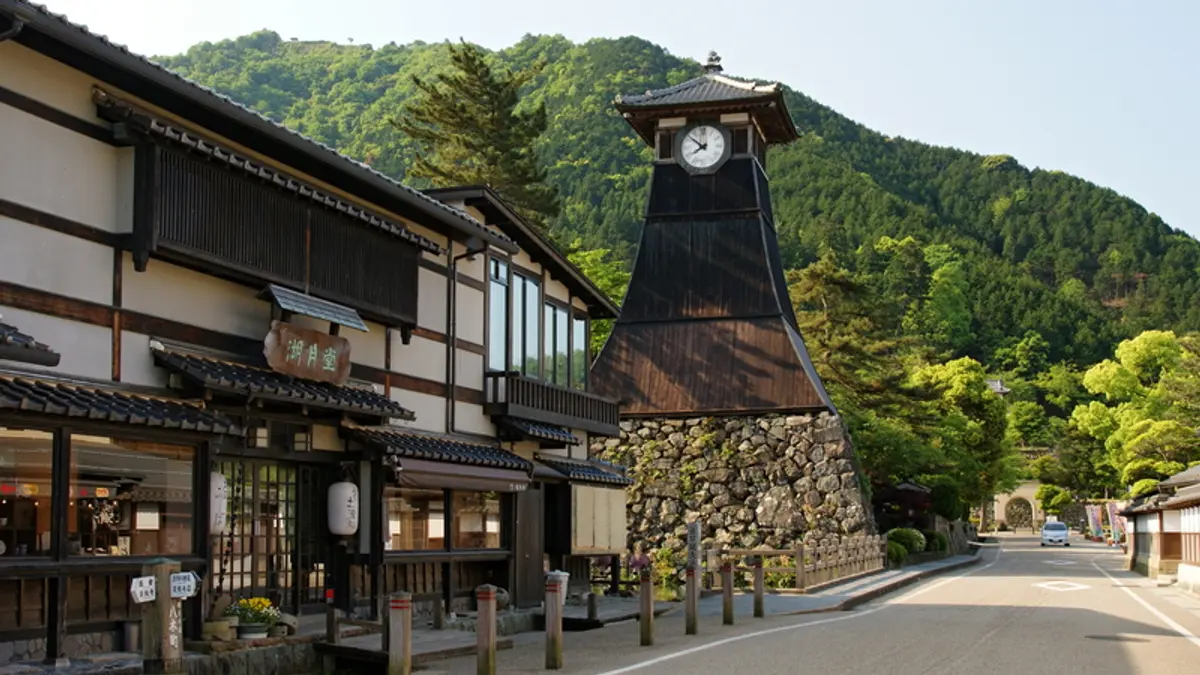
Discover a historic castle town in northern Hyogo, where traditional streets, a landmark clock tower, and a distinctive soba tradition offer a glimpse into another side of Japan.
A Castle Town in Northern Hyogo
In the northern part of Hyogo Prefecture, away from Japan's major cities, lies Izushi, a small historic town now part of Toyooka City.
Known as the Little Kyoto of Tajima, Izushi offers visitors a chance to explore a traditional Japanese castle town at a relaxed pace.
Its streets are lined with old merchant houses, historic buildings, temples, and reminders of the samurai era. At the center of town stands Shinkoro, an elegant clock tower that has become Izushi's best-known landmark.
Unlike Kyoto, with its expansive temple districts and large crowds, Izushi is compact. Many of its main attractions are within walking distance of one another.
A visit here is less about rushing between famous monuments and more about enjoying the atmosphere of a town whose history remains visible in everyday streets.
A Castle Town Shaped by History
Izushi's history stretches back long before the Edo period.
During the medieval and Sengoku periods, the surrounding area was associated with the Yamana clan, an influential warrior family. The region's castles included Arikoyama Castle, which stood on Mount Ariko, overlooking the town.
In 1604, Koide Yoshihide established Izushi Castle at the foot of the mountain. The surrounding settlement subsequently developed as the administrative and commercial center of the Izushi domain.
During the Edo period (1603–1868), Izushi prospered as a castle town. Samurai residences, merchant businesses, temples, and streets serving the domain helped shape its urban character.
The Sengoku family became the domain's rulers in 1706 and remained in power until the end of the feudal system.
A major fire in 1876 destroyed most of the town. Much of the historic streetscape seen today therefore reflects reconstruction and later preservation rather than buildings that have survived unchanged since the Edo period.
Even so, the traditional street layout, historic architecture, and relationship between the town and its former castle remain important parts of Izushi's identity.
In December 2007, approximately 23.1 hectares of central Izushi were designated an Important Preservation District for Groups of Traditional Buildings.
The designation recognizes the value of the historic townscape and supports efforts to preserve its distinctive character.
Why Is Izushi Called a Little Kyoto?
Across Japan, several towns are known as Little Kyoto, or Shokyoto in Japanese.
The expression is used for places whose streets, cultural traditions, or historical associations evoke aspects of Japan's former capital.
Izushi is often called the Little Kyoto of Tajima, referring to the historic Tajima region of northern Hyogo.
The nickname does not mean that Izushi is a miniature copy of Kyoto. Nor should it be understood as proof that its buildings or streets were directly modeled on the old capital.
Instead, it reflects the atmosphere created by Izushi's traditional townscape, temples, castle-town heritage, and local cultural identity.
Walking through its narrow streets, visitors encounter a quieter and more intimate setting than Kyoto's major sightseeing districts.
Izushi's appeal lies precisely in this difference. It is a historic town with its own story, not simply an imitation of somewhere else.
Shinkoro — The Clock Tower That Defines Izushi
Shinkoro is the most recognizable symbol of Izushi.
The tower was built in 1871 on a stone wall beside the former main gate of Izushi Castle.
Originally, it served as a structure from which a drum was sounded to announce the time. A clock was installed in 1881, and the tower began operating as a clock tower on September 8 of that year.
Today, its traditional roof and prominent clock face create one of the town's most familiar views.
Shinkoro stands near the historic center, making it a natural starting point for a walk around Izushi.
The surrounding streets also provide opportunities to photograph the tower against traditional buildings and the changing seasons.
Although the exterior can be enjoyed throughout the year, visitors should not assume that the tower's interior is open for regular sightseeing.
Shinkoro is best appreciated as a historic landmark and a symbol of the town's continuing connection to its past.
Izushi Castle Ruins — Traces of the Former Domain
A short walk from Shinkoro leads to the remains of Izushi Castle.
The castle was established in 1604, replacing the earlier mountaintop stronghold as the center of local administration.
The original castle buildings have not survived intact. What visitors see today includes surviving stone walls, historic site features, and reconstructed structures.
The corner turrets were reconstructed in 1968, while the entrance gate was reconstructed in 1994.
Together, these elements help visitors imagine the appearance and scale of the former castle.
One of the most distinctive sights is the row of red torii gates ascending the hillside toward Arikoyama Inari Shrine.
The contrast between the red gates, stone walls, and surrounding greenery makes this area especially photogenic.
Above the town rises Mount Ariko, where the earlier Arikoyama Castle once stood.
Visitors interested in the area's deeper history can appreciate how the castle ruins and mountain landscape reveal different stages of Izushi's development.
Walking Through Izushi's Historic Streets
One of the pleasures of visiting Izushi is that its historic center can be explored on foot.
Rather than following a strict sightseeing route, visitors can wander between old buildings, narrow streets, small shops, and traditional restaurants.
Several places are particularly worth noticing.
Izushi Meijikan
Izushi Meijikan is a historic Western-style building constructed in 1887.
Its architecture reflects the influence of Western design during the Meiji period, when Japan was rapidly modernizing.
The building provides an interesting contrast to the traditional Japanese architecture found elsewhere in town.
Eirakukan Kabuki Theater
Eirakukan opened in 1901 and is a notable example of a traditional Japanese theater building.
Its wooden architecture and historical atmosphere offer a glimpse into the entertainment culture of an earlier era.
Visitors should check current opening arrangements before planning to enter, as access and performances may vary.
Temples, Shops, and Everyday Streets
Beyond the major landmarks, Izushi rewards unhurried exploration.
Traditional storefronts, temple grounds, old-fashioned streets, and small details of the townscape help create its distinctive atmosphere.
Some of the most memorable moments may come from simply turning down a quiet side street or stopping to look at a building that has been carefully maintained.
Izushi is particularly appealing to travelers who enjoy photography, architecture, local history, and places where sightseeing can be combined with an ordinary walk through town.
Izushi Sara Soba — A Local Food Tradition
No visit to Izushi would be complete without trying Izushi sara soba.
Unlike many soba dishes served in a single large bowl or on one tray, Izushi sara soba is traditionally presented on several small plates.
A typical serving begins with five small plates of buckwheat noodles, although additional plates can usually be ordered.
The noodles are eaten with dipping sauce and a selection of accompaniments that may include green onions, grated daikon radish, wasabi, grated yam, and egg.
The combination allows diners to adjust the flavor as they eat.
According to local tradition, Izushi's soba culture was influenced by soba-making techniques brought from the Shinshu region when the Sengoku family arrived from Ueda in 1706.
The distinctive small-plate serving style is generally associated with a later development during the Edo period.
Today, soba restaurants are found throughout the historic center, and the dish is one of the town's strongest culinary attractions.
For many visitors, enjoying a leisurely soba lunch is as important as visiting the castle ruins or photographing Shinkoro.
Public Transport and Arriving in Izushi
Izushi does not have a passenger railway station.
For travelers using public transportation, Toyooka Station is the principal gateway.
From Toyooka Station, local buses operated by Zentan Bus connect the station area with Izushi. The journey generally takes around 30 minutes, depending on the service and traffic conditions.
Travelers arriving from Osaka, Kyoto, Kobe, or other cities can use the railway network to reach Toyooka before continuing by bus.
Some train journeys require additional changes depending on the departure station and selected service.
It is important to check both the railway timetable and the connecting bus schedule, particularly when traveling later in the day.
Visiting from Kinosaki Onsen
Kinosaki Onsen, a well-known hot spring town north of Toyooka, is another convenient base for exploring the region.
Visitors staying there can travel to Toyooka by train and continue to Izushi by bus.
Depending on the day and timetable, other bus connections may also be available. Travelers should confirm current services rather than assume that a direct bus operates at their preferred time.
For visitors who want to combine historic sightseeing with a traditional Japanese hot spring stay, Kinosaki Onsen and Izushi make an appealing combination.
How Much Time Should You Spend in Izushi?
Izushi is well suited to a half-day visit.
Allowing approximately three to four hours gives most visitors time to explore the main streets, see Shinkoro, visit the castle ruins, and enjoy a relaxed soba meal.
A shorter visit of two to three hours may be sufficient for travelers focusing on the central landmarks and lunch.
Those interested in architecture, photography, temples, or a slower walk through town may prefer to spend longer.
Because Izushi is compact, the experience is generally more enjoyable when visitors leave some flexibility in their schedule rather than trying to visit every attraction in a fixed order.
Where to Stay — Kinosaki Onsen
Although Izushi can be visited as a day trip, travelers exploring northern Hyogo may wish to stay overnight in nearby Kinosaki Onsen.
Kinosaki Onsen is known for its traditional ryokan, hot spring baths, and atmospheric streets.
Staying there makes it possible to explore Izushi's historic townscape and soba culture during the day, then return to a hot spring town for the evening.
This combination is especially attractive to travelers seeking both cultural sightseeing and a traditional Japanese accommodation experience.
Find Hotels and Ryokan in Kinosaki Onsen
Search Kinosaki Onsen accommodation on Klook
Third-party booking prices may include service fees.
A Little Kyoto with Its Own Character
Izushi is not a destination defined by one spectacular attraction.
Its charm comes from the relationship between its historic streets, castle ruins, clock tower, local food, and surrounding landscape.
The town's identity as the Little Kyoto of Tajima reflects an atmosphere that has been shaped by centuries of local history.
Yet Izushi remains distinctly itself.
For travelers interested in exploring Japan beyond its best-known cities, it offers a rewarding opportunity to experience the scale, rhythm, and traditions of a regional castle town.
Whether you come for the architecture, the history, the photography, or a plate of soba, Izushi invites you to slow down and enjoy a quieter side of Japan.
For more on the history and culture behind Japan's Little Kyoto towns, see Longing for Kyoto — Japan's “Little Kyoto” Towns and the Pull of the Old Capital.
Getting to Izushi — Transport Information
Izushi has no railway station. For most visitors arriving by public transport, the practical route is to travel to Toyooka Station and continue by Zentan Bus.
| From | Method | Transfers | Notes |
|---|---|---|---|
| Osaka | JR limited express + local bus | Varies by service | Travel to Toyooka Station, then take Zentan Bus to Izushi. |
| Kyoto | JR limited express + local bus | Varies by service | Travel to Toyooka Station, then take Zentan Bus to Izushi. |
| Kobe | JR trains + local bus | Varies by service | Reach Toyooka Station by rail, then continue by bus. |
| Himeji | JR trains + local bus | Varies by service | Rail connections to Toyooka vary by service. Continue by Zentan Bus. |
| Kinosaki Onsen | JR train + local bus | 1 via Toyooka | Travel to Toyooka Station, then take the bus to Izushi. |
| Toyooka Station | Zentan Bus | 0 | Direct local bus to Izushi; approximately 30 minutes. |
Rail connections and transfer counts depend on the selected service. Check current railway and bus schedules before departure.