Matsushima, Yamadera and Aizu: Where to Go in Miyagi, Yamagata and Fukushima
September 18, 2026
Miyagi, Yamagata and Fukushima are sometimes grouped together as Minami-Tohoku, or Southern Tohoku. The term is genuinely used in Japan, including in regional tourism cooperation, but it does not describe one uniform destination.
Sendai and Matsushima feel different from the mountains of Yamagata. Aizu feels different again.
That is why it makes more sense to choose a part of the region by what you want to do rather than by trying to “cover Southern Tohoku.”
Sendai and Matsushima make an easy first step into Tohoku
For many international visitors, Sendai is the simplest place to begin.
The city is directly connected with Tokyo by the Tohoku Shinkansen, making it an easy base for exploring the surrounding region. But Sendai is not simply a transport hub. Its history is closely associated with Date Masamune and the former Sendai domain, while food, shopping and everyday city life give it enough character to justify time of its own.
From Sendai, Matsushima is about 30 minutes away by train.
Hundreds of pine-covered islands spread across the bay, creating one of Japan's classic coastal landscapes. Zuiganji adds a much older religious and historical layer to the visit.
In a short distance, the journey shifts from a modern regional city to temples, islands and sea.
For someone making a first trip beyond Tokyo into Tohoku, that combination is hard to overcomplicate.
And that is a virtue.
In Yamagata, the mountains stop being background scenery
Travel west into Yamagata and the landscape begins to shape the trip more directly.
Yamadera, officially Risshakuji Temple, climbs a mountainside through cedar forest. More than 1,000 stone steps lead upward through the temple grounds to viewpoints over the valley below. The temple was founded in 860, but for most visitors the experience is as much about the climb and the setting as the historical date.
Farther south, Zao changes dramatically with the seasons.
In warmer months, the mountains are a place for scenery and hiking. In winter, they become a major ski area and are famous for trees covered deeply in snow.
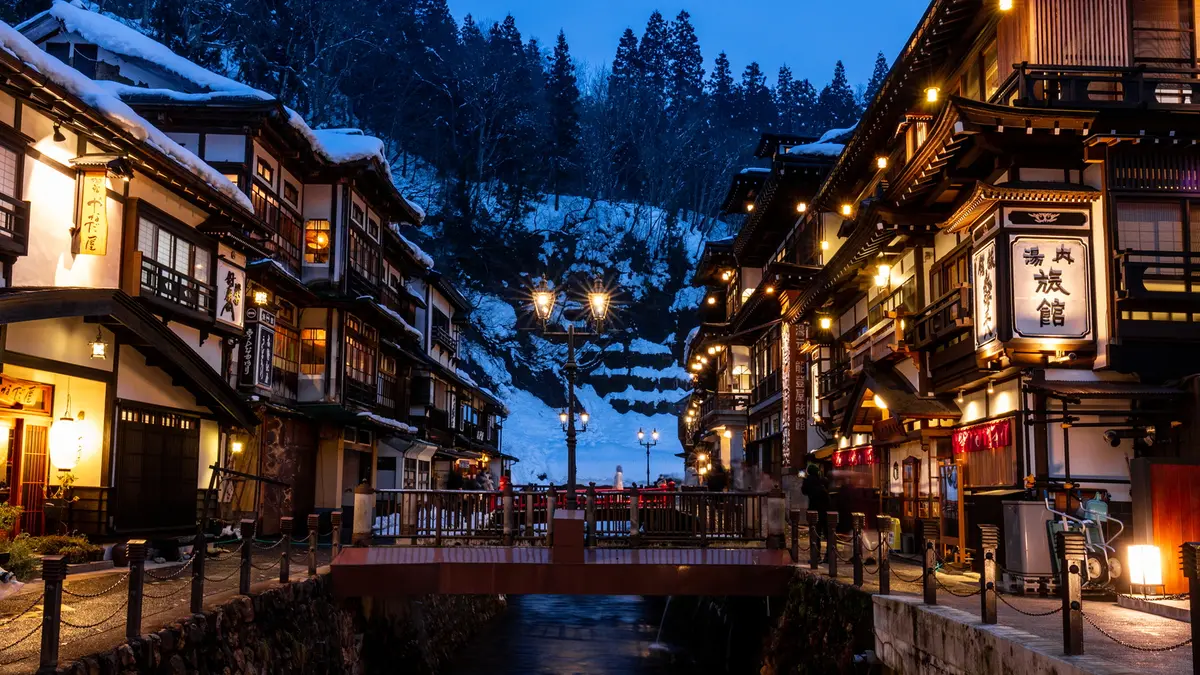
Then there is Ginzan Onsen, a small hot-spring town lined with traditional inns along a river.
It is tempting to treat Ginzan Onsen as a place to arrive, take photographs and leave. An overnight stay makes much more sense if the atmosphere of the town is part of the reason for going.
Yamagata rewards choosing one part of the prefecture and slowing down.
The prefecture extends all the way to Shonai on the Sea of Japan, and trying to see everything quickly can turn the trip into more transport than travel.
Aizu gives Fukushima a very different character
In western Fukushima, Aizu-Wakamatsu offers another kind of regional journey.
The city developed as a castle town and remains strongly associated with samurai history. Tsuruga Castle is its most visible landmark, while lacquerware, sake and the surrounding old streets add to the sense that Aizu has its own identity within Fukushima.
From Aizu-Wakamatsu, Ouchi-juku introduces a different historical landscape.
The former Edo-period post town is known for its thatched-roof buildings along the old road. Reaching it usually involves local rail followed by bus or taxi, so it works better as a planned outing than as an accidental stop.
To the north, Urabandai changes the journey again.
The Goshikinuma ponds were formed after the eruption of Mt. Bandai. Differences in minerals and water chemistry can give the ponds strikingly different colors, and a walking trail links several of them.
Within one part of Fukushima, a trip can move from samurai history to an old post town and then into volcanic mountain scenery.
The map is closer than the journey sometimes feels
Miyagi, Yamagata and Fukushima are neighboring prefectures, but traveling between their destinations does not always produce a neat route.
Railways tend to follow valleys and major corridors, while mountains sit between places that look close on a map.
A compact trip can work very well around Sendai and Matsushima.
Yamadera, Zao and Ginzan Onsen usually reward a slower plan.
Aizu and the Bandai area can easily justify several days of their own.
There is no prize for collecting all three prefectures.
Think of the name as a way to organize the map
“Southern Tohoku” is useful when first looking at a map.
After that, it is often better to forget the label.
Go to Matsushima for islands, temples and the sea.
Go into Yamagata for mountains and onsen.
Go to Aizu for history, then continue toward the Bandai landscape if that is what interests you.
They happen to sit in neighboring prefectures.
They do not have to become the same trip.
Where to stay
Planning to stay overnight? Find accommodation in: