Visiting Mount Fuji Safely and Respectfully: What Travelers Should Know
September 19, 2026
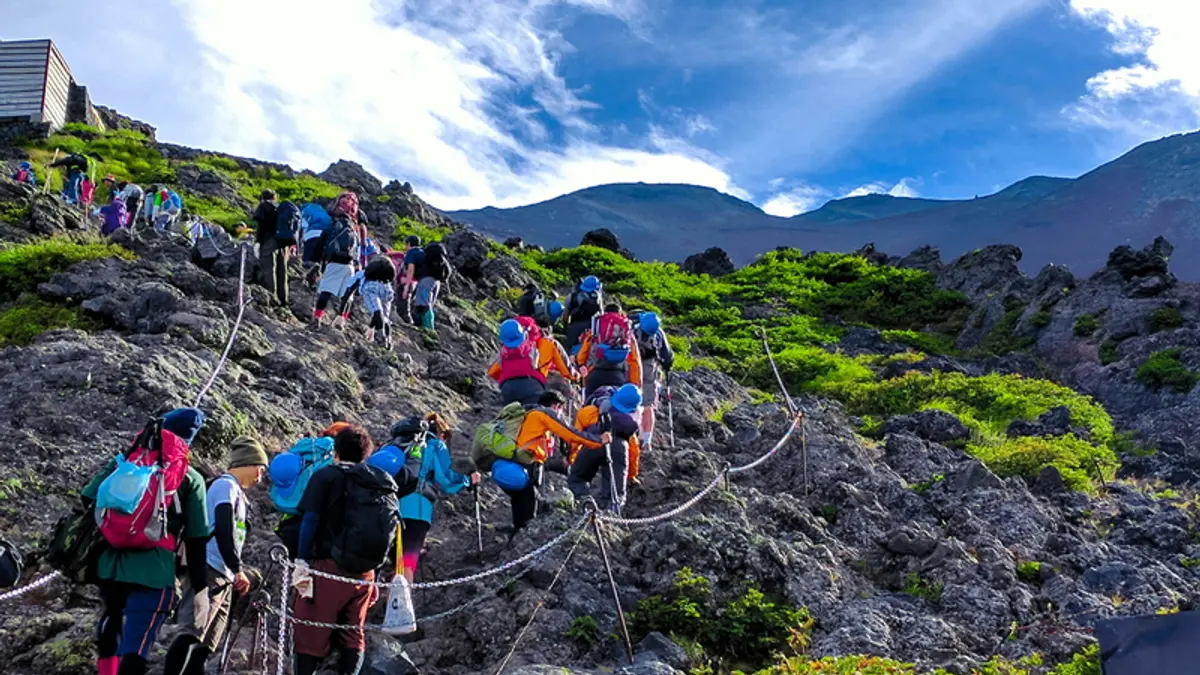
Mt. Fuji is one of the most recognizable places in Japan.
It is also Japan's highest mountain at 3,776 meters, an active volcano, part of a World Heritage property, and a place where cold, altitude, exhaustion and rapidly changing weather can turn a sightseeing mindset into a serious emergency.
The first thing to understand is simple:
Visiting Mt. Fuji and climbing Mt. Fuji are not the same trip.
You can enjoy the mountain from the Fuji Five Lakes, surrounding towns and many viewpoints without climbing at all.
If you do decide to climb, treat Mt. Fuji as a mountain—not as an extension of ordinary sightseeing.
Check the climbing season and current rules before you go
The rules for climbing Mt. Fuji have become more structured in recent years and may change from season to season.
For the 2026 season, the Yoshida Trail operated from July 1 to September 10. Climbers paid a ¥4,000 hiking fee, entry between 2 p.m. and 3 a.m. was restricted for people without mountain-hut accommodation, and the route had a daily limit of 4,000 climbers, excluding mountain-hut guests from that limit. Required equipment was also checked at the 5th Station. (fujisan-climb.jp)
On the Shizuoka side, the Subashiri Trail operated from July 1 to September 10 and the Fujinomiya and Gotemba trails from July 10 to September 10. The 2026 system required a ¥4,000 hiking fee, pre-climb learning, and mountain-hut accommodation for entry between 2 p.m. and 3 a.m. (fujisan-climb.jp)
The 2026 summer climbing season has ended.
Do not assume that the same dates or rules will apply in a future year. Check the official Mt. Fuji climbing information for the season in which you actually plan to climb.
Never attempt a bullet climb or climb without proper equipment
Two particularly dangerous patterns on Mt. Fuji are bullet climbing and climbing without proper mountain equipment.
These are not simply questions of etiquette.
They can lead to altitude sickness, hypothermia, falls, injury and situations in which a climber can no longer move safely.
Both can become life-threatening. Do not attempt them.
Bullet climbing: Do not climb through the night without proper rest
Bullet climbing involves attempting to reach the summit by climbing through the night without staying in a mountain hut and without obtaining sufficient sleep or rest, often with the aim of reaching the summit for sunrise. Official Mt. Fuji guidance warns that this can cause altitude sickness and hypothermia. (fujisan-climb.jp)
Mt. Fuji rises to 3,776 meters.
Gaining altitude rapidly can cause headache, nausea, dizziness and other symptoms of altitude sickness. When this is combined with sleep deprivation, physical exhaustion becomes worse and judgment and concentration deteriorate.
Nighttime also makes the trail harder to see and increases the consequences of a stumble, fall or rockfall incident.
Near the summit, even summer conditions can become extremely cold. A tired climber exposed to rain and strong wind is at greater risk of hypothermia.
Do not think:
“I came all this way, so I have to see sunrise from the summit.”
If your itinerary only works by climbing through the night without adequate rest, change the itinerary.
The mountain will still be there.
Poorly equipped climbing: Mt. Fuji is not a city walk
The second major problem is climbing without equipment suitable for a high mountain.
Sneakers, jeans, shorts, T-shirts or a thin jacket may be completely normal sightseeing clothes.
They are not adequate preparation for Mt. Fuji.
Climbers need appropriate footwear, waterproof clothing, warm layers, water, food and a light source, as well as enough preparation for the weather and the route.
For the 2026 Yoshida Trail, Yamanashi required climbers to have cold-weather clothing, two-piece rain gear and footwear suitable for climbing before passing the 5th Station gate. (fujisan-climb.jp)
Mountain weather can change rapidly.
Rain-soaked clothing combined with strong wind can remove body heat quickly. Unsuitable footwear increases the risk of slipping or injury, while the absence of a headlamp can leave a climber unable to move safely after dark.
Mt. Fuji is famous, buses travel high onto the mountain, and large numbers of other visitors may be around you.
None of that makes the mountain harmless.
Some people climbing Mt. Fuji are not adequately prepared
Inadequately prepared climbing has become a real safety issue.
Yamanashi Prefecture has repeatedly identified lightly equipped climbing as a problem. In August 2025, the prefecture reported that Fuji Rangers had provided guidance to about 630 climbers as part of its response to the issue. More recent prefectural information also says the Rangers continue to provide guidance to lightly equipped and bullet climbers at the 5th Station. (pref.yamanashi.jp)
The important point is not who the climber is.
Bullet climbing and poorly equipped climbing are dangerous for everyone.
Mt. Fuji's worldwide fame and relatively easy access to the 5th Station can create the mistaken impression that the summit is an extension of an ordinary sightseeing visit.
It is not.
Rescue calls are a real problem
These risks are not theoretical.
The Ministry of the Environment reported that during the 2024 climbing season, hypothermia, altitude sickness and injuries occurred frequently and, as in previous years, there were many rescue requests. It reported further rescue requests involving altitude sickness, trauma and hypothermia during the 2025 season. (kanto.env.go.jp)
Poor preparation on Mt. Fuji can become a rescue situation surprisingly quickly.
Altitude sickness can affect fit people
Being young, healthy or athletic does not make someone immune to altitude sickness.
Official safety guidance recommends resting for about one or two hours near the 5th Station to acclimatize, walking at a slow and steady pace, staying hydrated and taking regular breaks. (fujisan-climb.jp)
Headache, nausea, dizziness, unusual weakness or worsening physical condition should not be treated as something to endure simply because reaching the summit is important.
If your condition becomes serious, descend.
Turning around is not failure.
Getting safely back down the mountain is part of climbing it.
Mountain huts are not ordinary hotels
Mountain huts exist to support climbers.
Accommodation is basic, space is limited and water is precious.
Do not assume that you can simply arrive late at night and find somewhere to sleep.
Plan and reserve where required.
A mountain-hut reservation also does not replace whatever entry registration or fee procedure applies during that season.
Respect the mountain itself
Stay on established trails.
Take your trash with you.
Do not remove lava, rocks or plants.
Avoid unnecessary noise around mountain huts and resting climbers.
Yamanashi's climbing rules explicitly require climbers to stay on the route, take trash home and leave lava and plants where they are. (pref.yamanashi.jp)
Mt. Fuji receives enormous numbers of visitors.
A small action repeated thousands of times is no longer a small action.
Respect the communities below the mountain too
Responsible travel does not end when the climb is over.
The Fuji Five Lakes and surrounding areas include homes, farms, schools, shops and ordinary roads.
They are not outdoor film sets.
Do not enter private property for a photograph.
Do not stand in the roadway.
Do not block driveways, shops or pedestrian traffic.
A photograph is never important enough to put yourself or somebody else in danger.
Preparation gives you more freedom, not less
Rules around Mt. Fuji have become stricter because authorities have had to manage safety, congestion and environmental pressure.
That does not mean visitors should approach the mountain nervously.
The opposite is true.
Good preparation creates freedom.
Know the current rules.
Carry the correct equipment.
Leave enough time.
Change your plan when the weather turns bad.
And be willing to stop when your body tells you to stop.
Mt. Fuji should feel adventurous. It does not need to feel reckless.