Castle Towns, Forests and Sanriku: Where to Go in Aomori, Akita and Iwate
September 18, 2026
Aomori, Akita and Iwate are often grouped together in Japan as Kita-Tohoku, or Northern Tohoku. The name is useful, and the three prefectures have a long history of regional cooperation, but it can also make a very large area look simpler than it really is.
For a traveler, that distinction matters.
A few days spent in Hirosaki and Kakunodate will feel very different from a journey through Oirase and Lake Towada. Morioka and Hiraizumi offer another kind of trip again, while reaching the Sanriku Coast shifts the journey toward the Pacific.
So there is no need to begin by asking how to visit all three prefectures.
A better question is: what do you actually want to experience?
Start with the towns if history matters most
Northern Tohoku has several historic destinations, but they belong to different periods and tell different stories.
Hirosaki developed as a castle town in the Tsugaru region of Aomori. Hirosaki Castle remains its best-known landmark, while part of the former castle town survives in the nearby samurai district.
Across the mountains in Akita, Kakunodate is smaller and quieter. Founded as a castle town in the early 17th century, it is especially known for its preserved samurai district and traditional residences. The Akita Shinkansen stops at Kakunodate, which makes this unusually atmospheric small town relatively easy to include in a rail journey.
Then there is Hiraizumi in southern Iwate.
Hiraizumi belongs to an earlier chapter of Japanese history. It flourished under the Northern Fujiwara in the 11th and 12th centuries, and its temples, gardens and archaeological sites are now part of a UNESCO World Heritage property. Chusonji and its gold-covered Konjikido are the best-known sights.
It is tempting to put Hirosaki, Kakunodate and Hiraizumi into one box marked “historic Japan.” In practice, they do not feel interchangeable at all.
That is part of the fun.
Leave the towns and the journey becomes much quieter
If the reason for coming north is nature, the Oirase–Towada area is one of the strongest choices.
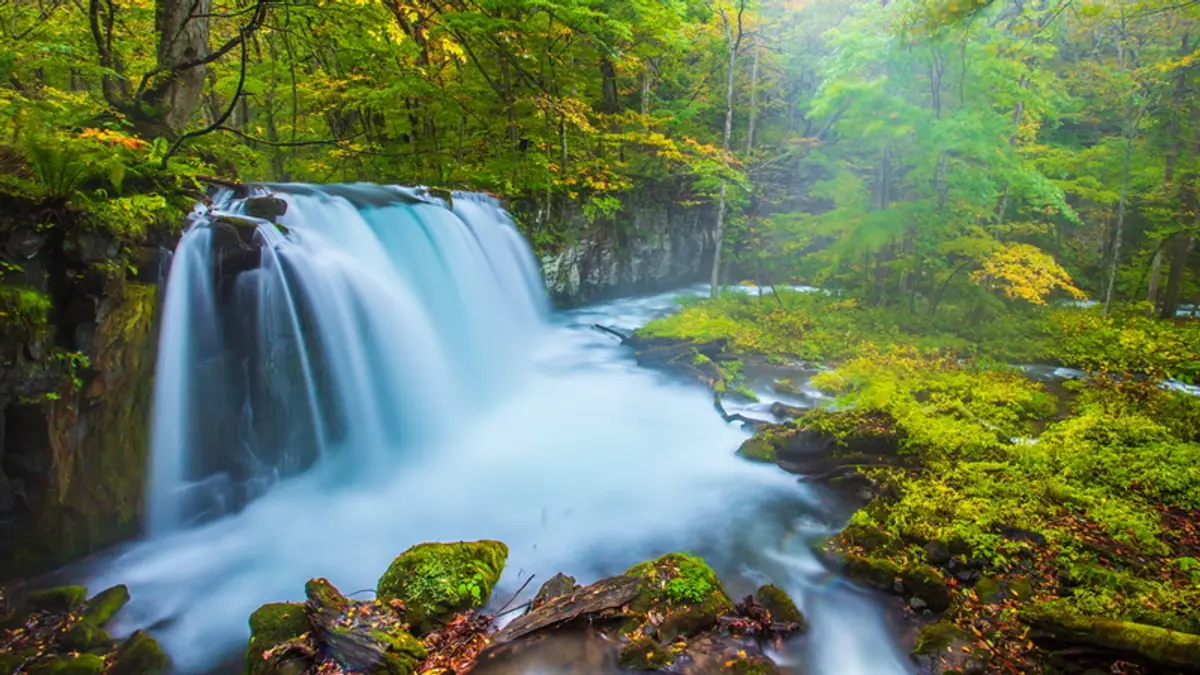
Oirase Gorge follows a forested stream for about 14 kilometers, with waterfalls, moss-covered rocks and dense woodland along the way. It runs down from Lake Towada, while the nearby Hakkoda Mountains add another landscape entirely.
This is a part of Tohoku where rushing usually works against the experience.
Akita offers a similar change of pace around Lake Tazawa and Nyuto Onsenkyo. Lake Tazawa is Japan's deepest lake, while Nyuto Onsenkyo lies in the mountains nearby and consists of seven hot-spring areas surrounded by forest. Public buses connect the hot-spring area with Tazawako Station.
A night in the mountains can make more sense here than adding another sightseeing stop.
Sometimes the point of the trip is simply to stop moving for a while.
Do not treat Morioka as only a station
Morioka is the obvious transport center for much of Iwate, which also makes it easy to underestimate.
The city has enough history, food and everyday atmosphere to justify time of its own. The stone walls of the former Morioka Castle remain in the center, while rivers and surrounding mountains keep the city visually connected to the landscape around it.
Food is part of Morioka's identity as well. Wanko soba, reimen and jajamen are not simply dishes that happen to be served there; they are part of how the city is known in Japan.
Farther north, Hachinohe offers another urban stop with a strong connection to seafood. The large Hasshoku Center alone has more than 60 shops selling seafood and regional products.
Neither city needs to be treated as somewhere you merely pass through on the way to a more famous attraction.
Sanriku deserves its own time
Travel east from Morioka and the map becomes deceptive.
The Sanriku Coast may not look far away, but reaching the Pacific side and then moving along the coast takes time. For example, Miyako and Jodogahama are reached from Morioka by a combination of rail or bus and local transport.
That is a reason to give Sanriku more time, not less.
At Jodogahama, white rock formations, green pines and blue water form one of Iwate's best-known coastal landscapes. Sanriku Fukko National Park also preserves landscapes and communities shaped by the 2011 Great East Japan Earthquake and tsunami, and visitors will encounter that history in museums, memorials and local interpretation throughout the coast.
A visit here feels very different from Hiraizumi or Morioka.
It should.
So where should you go?
If castle towns and old streets are what brought you north, Hirosaki and Kakunodate make natural anchors, with Hiraizumi adding a much earlier layer of history.
If forests, lakes and hot springs matter more, Oirase, Towada and the mountain areas of Akita deserve more time than a quick stop.
If you want a city in the middle of the journey, Morioka works well without feeling like a large metropolitan detour.
And if the Pacific coast is what interests you, give Sanriku enough time to become the trip rather than an excursion from it.
Aomori, Akita and Iwate may be grouped together as Northern Tohoku.
On the ground, however, there is no single Northern Tohoku trip.
There are several very different ones.
Where to stay
Planning to stay overnight? Find accommodation in: